


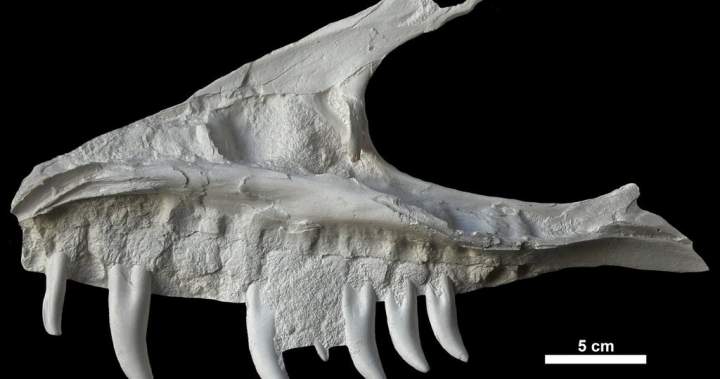
A remarkable paleontological discovery at a British Columbia campground has been officially identified as belonging to a fearsome predator that stalked the prehistoric landscapes of Western Canada millions of years before the legendary Tyrannosaurus rex ever existed. University of Alberta researchers have confirmed that the partial skull impression found in Tumbler Ridge belongs to a Gorgosaurus, a swift and agile tyrannosaur species.
A Hiker’s Extraordinary Find Becomes Scientific Breakthrough
The story behind this groundbreaking discovery began back in 2017 when B.C. resident Rick Lambert stumbled upon an unusual rock formation during a hiking excursion at a campground near Tumbler Ridge, close to the Alberta border. Lambert’s childhood experience hunting for fossils in England had trained his eye to recognize potentially significant geological specimens, though he credits an unexpected helper—a squirrel—for drawing his attention to the rock near the river’s edge.
What Lambert uncovered that day would eventually be confirmed as the first tyrannosaur skull ever found in British Columbia. The Tumbler Ridge Museum Foundation dispatched one of their paleontologists to examine the find, setting in motion years of research that culminated in findings published in the scientific journal Palaeogeography, Palaeoclimatology, Palaeoecology in June 2026.
“We were able to identify Gorgosaurus based on a unique set of characteristics on this impression,” explained lead study author Colton Coppock from the University of Alberta.
Meet the T. Rex’s Faster, Lighter Ancestor
The Gorgosaurus libratus, as the species is formally known, roamed the ancient territories of what is now Western Canada approximately 76 million years ago—roughly 10 million years before the T. rex made its appearance on Earth. This timeline places Gorgosaurus as an evolutionary predecessor to its more famous cousin, earning it the affectionate nickname of the T. rex’s “great-uncle.”
According to the Royal Tyrrell Museum in Alberta, these impressive predators could reach lengths of up to nine metres. However, despite sharing certain physical characteristics with the T. rex, the Gorgosaurus had several distinctive features that set it apart:
- A more lightly built body structure compared to T. rex
- Longer limbs designed for speed and agility
- Distinctive triangular horns positioned above its eyes
- Similar stubby arms and long tail as its later relative
- A specialized jaw structure with unique bone formations
Coppock described the Gorgosaurus as essentially a “faster T. rex,” suggesting these dinosaurs were built for quick pursuit of prey rather than the brute-force hunting style associated with their more massive descendants.
Scientific Analysis Reveals Prehistoric Secrets
The identification process required meticulous analysis of the partial skull impression, which included the dinosaur’s maxilla, or upper jaw. While most of the actual bone material had eroded over the millennia, the impression preserved in sandstone was detailed enough for researchers to create a highly accurate cast that retained the skull’s unique characteristics.
Coppock received the cast during a casual barbecue gathering in August 2025, when his supervisor placed it in his lap. His immediate reaction confirmed what many had suspected—the specimen belonged to a Gorgosaurus libratus. The research team identified several key indicators linking the partial skull to this specific species:
- Distinctive bone sutures in the nasal region
- A unique rod of bone separating openings in the upper jaw
- Internal surface characteristics matching known Gorgosaurus specimens
- Dental evidence suggesting the dinosaur was likely a juvenile
The Tumbler Ridge Museum Foundation continues to preserve the original impression under strict environmental controls, recognizing its immense scientific and historical value. Museum curator Eamon Drysdale noted that while the region contains abundant dinosaur material, actual bone specimens remain relatively rare, making this discovery particularly significant for understanding the prehistoric ecosystem of the area.
A Window Into Canada’s Prehistoric Past
This discovery adds to the growing body of evidence that Western Canada was once a thriving habitat for tyrannosaur species. Gorgosaurus is already one of the most well-documented tyrannosaurs found in Alberta, with numerous specimens recovered from the province’s famous Dinosaur Park Formation. This wealth of comparative material gave Coppock and his co-authors substantial resources for confirming the identity of the B.C. specimen.
For the Latin community in Canada and dinosaur enthusiasts across the country, this find serves as a powerful reminder that extraordinary discoveries can happen in unexpected places—sometimes with the help of a curious squirrel and a hiker with a trained eye for the unusual.
