


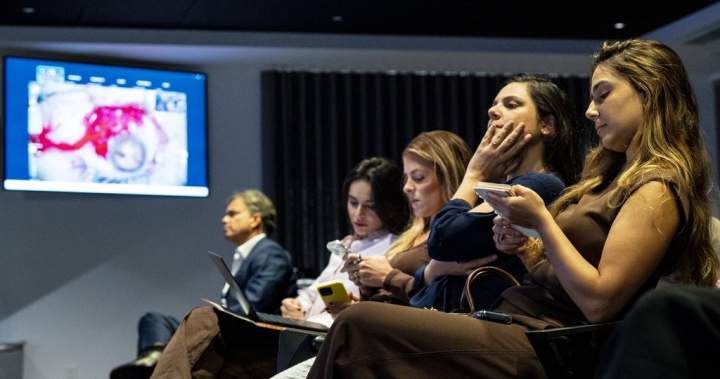
In a groundbreaking move that positions Quebec at the forefront of medical education, Maisonneuve-Rosemont Hospital in Montreal has begun livestreaming intricate eye surgeries to train physicians from around the globe. The initiative, launched on July 15, 2026, represents a significant leap forward in how surgical techniques are taught and shared within the medical community.
Revolutionary Approach to Surgical Education
The Angus Centre for outpatient ophthalmic surgery has set its sights on becoming an international leader in live surgical broadcasting. Dr. Flavio Rezende led the initiative by performing a series of retinal surgeries that were transmitted in real-time to an observation room in downtown Montreal, where medical professionals gathered to witness the procedures as they unfolded.
The timing of the broadcast was strategic, coinciding with the annual American Society of Retina Specialists congress taking place in the city. Physicians from multiple countries had the opportunity to observe Dr. Rezende’s techniques, which included cases of varying complexity to demonstrate a wide range of surgical approaches.
“I find it really useful because it helps you understand the thought process of the surgeon performing the procedure. You can try to apply some of the things you learned during the session.”
These words from Dr. Fares Antaki, a vitreoretinal surgeon who will join the Centre hospitalier de l’Université de Montréal in September, highlight the immense value that live surgical observation provides to medical professionals seeking to enhance their skills.
Four Years in the Making
The livestreaming project did not come together overnight. Hospital staff and technicians spent approximately four years organizing the broadcast infrastructure, which required:
- Specialized high-definition cameras capable of capturing microscopic surgical details
- A robust high-speed internet connection to prevent any lag during transmission
- Coordination between surgical teams and technical support staff
- Development of protocols for real-time interaction between viewers and surgeons
Retinal surgery demands exceptional precision, as surgeons work with microscopic structures within the eye. The Maisonneuve-Rosemont facility has developed particular expertise in performing these delicate procedures using a small tube equipped with a camera that allows surgeons to visualize the retina even when traditional viewing methods are compromised.
Overcoming Physical Limitations
Dr. Rezende explained that certain patients present unique challenges that require innovative approaches. When a patient’s cornea becomes opaque due to trauma or other conditions, traditional surgical visualization becomes impossible. The camera-equipped tube technology developed at the Montreal facility allows surgeons to continue operating in these challenging circumstances.
Dr. Cynthia Qian, a retinal surgeon and colleague of Dr. Rezende, emphasized another crucial advantage of live broadcasting: authenticity. She noted that at typical medical conferences, lengthy procedures lasting five hours or more are often condensed into brief two-minute presentations, which fail to capture the reality of surgical practice.
Bridging the Gap Between Training and Reality
Dr. Bruna Gil Ferreira, a retinal surgeon who completed her postgraduate training at Université de Montréal and currently practices in Brazil, praised the initiative for its practical approach to education. She pointed out that traditional courses often focus exclusively on straightforward, textbook cases that rarely reflect the unpredictable nature of real surgical situations.
The live format allows observers to witness how experienced surgeons adapt to unexpected complications and make critical decisions in real-time. This exposure is invaluable for developing the problem-solving skills that young surgeons will need throughout their careers.
Combating Medical Misinformation
Beyond education, Dr. Rezende has expressed concern about the proliferation of low-quality surgical videos on social media platforms. He sees the livestreaming initiative as an opportunity to establish a reliable source of high-quality surgical content.
- Quality control measures ensure only accurate techniques are demonstrated
- Expert commentary provides proper context for viewers
- Interactive sessions allow for questions and clarifications
- Archived broadcasts create a library of verified educational material
The space constraints of typical operating rooms have long limited the number of observers who can witness procedures firsthand. By broadcasting surgeries to larger venues, the Maisonneuve-Rosemont initiative democratizes access to surgical education, allowing significantly more medical professionals to benefit from each procedure performed.
As Montreal positions itself as a hub for innovative medical education, this livestreaming program demonstrates how technology can transform the training of future surgeons while maintaining the highest standards of patient care and surgical excellence.
