


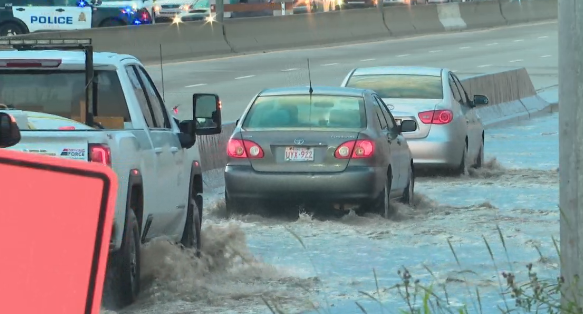
Residents of Edmonton woke up on July 15, 2026, to scenes of significant urban flooding after a powerful overnight thunderstorm swept through the city’s north side. The Yellowhead Trail, one of the city’s major transportation arteries, became the epicenter of the flooding chaos, prompting emergency closures and traffic diversions throughout the morning hours.
Widespread Road Closures and Traffic Disruptions
City officials moved quickly to address the dangerous conditions, closing multiple on-ramps to the Yellowhead Trail to allow emergency crews safe access to the affected areas. The flooding impact stretched across a considerable portion of the freeway, affecting both eastbound and westbound traffic between 121 Street and 156 Street.
Initial assessments from Edmonton Police indicated that underpasses near the Yellowhead Trail corridor, spanning from 97 Street to 184 Street, were experiencing substantial water accumulation. The situation proved severe enough that several motorists were forced to abandon their vehicles in rising waters, with dramatic scenes observed at the 127 Street and 127 Avenue underpass where a manhole cover had been forced open by water pressure.
- On-ramps to Yellowhead Trail closed for emergency access
- Flooding reported from 97 Street to 184 Street underpasses
- Freeway affected in both directions between 121 Street and 156 Street
- Multiple vehicles abandoned due to water levels
- Traffic signals malfunctioning at several major intersections
Emergency Response and Interagency Coordination
The City of Edmonton deployed multiple teams to address the flooding emergency, coordinating efforts with Edmonton Fire Rescue Services, Edmonton Police Service, and EPCOR utility services. These combined forces worked at various locations throughout the morning to pump water, clear debris, and safely reopen roads as conditions improved.
Beyond the major flooding on Yellowhead Trail, several traffic signals across the city experienced technical difficulties due to the storm. Drivers reported significant delays at key intersections, particularly along St. Albert Trail at 128 Avenue, 142 Street at 91 Avenue, and 97 Street at 124 Avenue. Transit services also faced disruptions, prompting officials to advise commuters to allow extra travel time.
“We’ve seen a really small concentration of heavy rain that is unlike what we saw in a long, long time,” stated Mayor Andrew Knack, describing the unusual intensity of the overnight storm.
Long-Term Flood Mitigation Efforts
Mayor Knack acknowledged that while the flooding caused significant disruption, the city has been preparing for such events through a comprehensive flood mitigation program. Since 2019, Edmonton has been implementing a $1.6 billion, 20-year infrastructure project designed to make the city more resilient against changing weather patterns and increasingly severe storm events.
However, the mayor was realistic about the limitations of even well-planned infrastructure when facing concentrated rainfall. Low-lying areas and underpasses will continue to be vulnerable to flash flooding during intense storm events, regardless of mitigation efforts.
“Flood mitigation work is designed to broadly help all communities to try to minimize the opportunity for water to pool on local roads, which in turn gets into people’s homes. But where you have low points, you’re always going to have some tension when you have a really heavy concentration of rain in a short amount of time,” Mayor Knack explained.
What This Means for Edmonton Residents
For members of the Latin community and all Edmonton residents, this flooding event serves as an important reminder about storm preparedness and the realities of urban infrastructure during extreme weather. The following precautions are recommended during similar events:
- Avoid driving through flooded roadways, as water depth can be deceptive
- Check city social media accounts for real-time road closure updates
- Allow extra commute time when storms are forecasted
- Never attempt to drive around road closure barriers
- Report flooding or abandoned vehicles to emergency services
As Edmonton continues to experience the effects of climate change through more intense and localized storm events, residents can expect the city to continue investing in infrastructure improvements. The July 15, 2026 flooding event, while disruptive, demonstrated the importance of the ongoing mitigation efforts and the need for continued vigilance during severe weather conditions.
