


Three decades have passed since catastrophic flooding devastated Quebec’s Saguenay region, yet for survivors like France Roy, the traumatic memories remain as fresh as ever. On July 20, 2026, marking the 30th anniversary of one of Quebec’s most destructive natural disasters, Roy opened up about the harrowing experience that forever changed her life and the lives of thousands of residents in eastern Quebec.
A Night of Terror: Escaping the Rising Waters
Roy was residing in the rural area of La Baie, close to the Rivière-à-Mars, when unprecedented rainfall struck the region between July 19 and 21, 1996. Speaking from her current home in Chicoutimi, she described the terrifying moments when nature’s fury descended upon her community without warning.
“It’s a memory that’s still engraved in my mind. When I think about it 30 years later, it still makes me sad. I saw the river starting to come into our driveway. The water was so loud, the river made so much noise.”
Alone with her three children, all under the age of seven at the time, Roy faced an unimaginable situation. Her sister rushed to alert her that the river was about to overflow its banks. As the water level rose rapidly around their home, a neighbour arrived with his camper van to help the family escape the dangerous conditions.
The escape itself proved treacherous, as conventional routes had already been submerged by the floodwaters. Roy and her children were forced to navigate through old trails since the main roads had become impassable. She described the experience as absolutely terrifying, not knowing if they would make it to safety.
The Devastating Impact on Saguenay Communities
The 1996 Saguenay flood stands as one of the most significant natural disasters in Canadian history. The statistics paint a sobering picture of the destruction that unfolded during those fateful days in July:
- Over 155 millimetres of rain fell in some areas within just 24 hours
- Approximately 14,000 people were displaced from their homes
- Ten lives were tragically lost during the disaster
- Hundreds of houses were completely destroyed
- Critical infrastructure including roads and bridges was washed away
- Several communities were temporarily isolated from the rest of the province
The economic toll was staggering, with total damages later estimated at nearly one billion dollars. The disaster prompted years of reconstruction efforts throughout the region, including the construction of new reservoirs, upgraded dam systems, and various flood-control measures designed to prevent similar catastrophes in the future.
Long-lasting Emotional Scars
For Roy’s family, the physical damage was significant but ultimately repairable. Approximately four feet of water had filled their basement by the time the flooding subsided. The family spent three weeks displaced before they could finally return to their home and begin the recovery process.
However, the psychological impact proved far more difficult to overcome. Roy revealed that the trauma affected her for many years following the disaster. Whenever news reports featured flooding events anywhere in the world, she would find herself overcome with emotion, often crying as painful memories resurfaced.
The images she witnessed during those terrifying days continue to haunt her memory. She compared the scenes to something out of a horror film, watching helplessly as houses were swept away by the raging waters and massive tree trunks floated down the Saguenay River. Seeing rooftops carried along by the current left a disturbing impression that has never fully faded.
A Symbol of Resilience Emerges
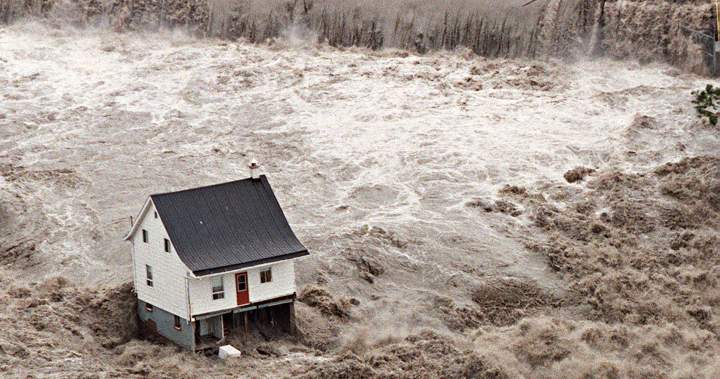
Amid the widespread destruction, one image emerged as an enduring symbol of hope and resilience for the Saguenay region. A small white house in Chicoutimi miraculously survived the disaster, standing firm despite being completely surrounded by violent floodwaters. This remarkable structure was later preserved and transformed into a museum dedicated to commemorating the flood and honoring those affected.
Roy visited the museum years after the disaster, finding that the experience brought back not only memories of destruction but also powerful recollections of community solidarity. During the crisis and its aftermath, neighbours helped neighbours, strangers assisted strangers, and the entire region came together in ways that demonstrated the strength of human connection during times of adversity.
Supporting Survivors and Building Resilience
The Canadian Red Cross played a crucial role in the disaster response, ultimately providing assistance to approximately 18,000 people affected by the flooding. The organization’s efforts helped countless families like Roy’s begin the long process of rebuilding their lives and their communities.
The lessons learned from the 1996 Saguenay flood have informed emergency preparedness and response protocols across Quebec and Canada. Infrastructure improvements implemented in the decades since have aimed to better protect communities from similar extreme weather events, though climate change continues to pose ongoing challenges for flood-prone regions.
As Roy reflects on the 30th anniversary of this life-altering event, her message centers on the importance of community bonds and mutual support during times of crisis. Despite the fear, the losses, and the lasting emotional impact, what remains most prominent in her memory is how people came together to help one another through the darkest moments.
