


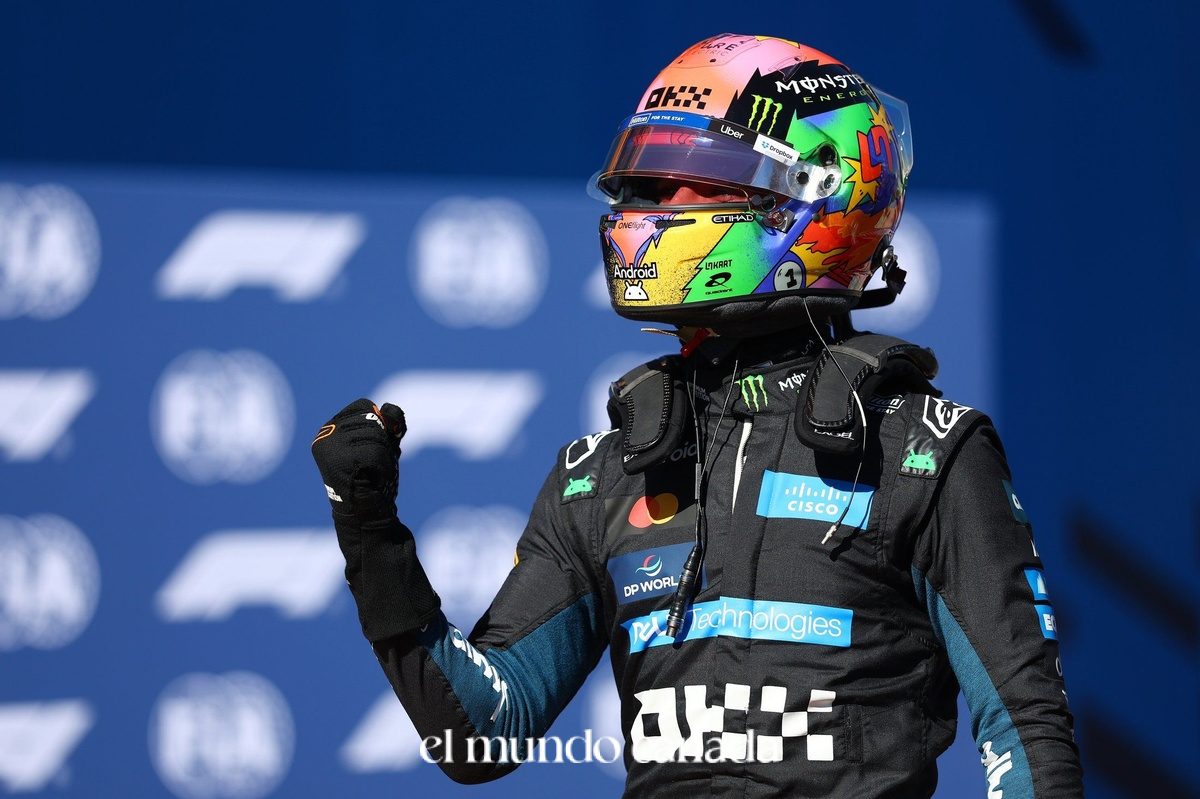
On September 12, 2026, reigning Formula 1 champion Lando Norris delivered what McLaren team principal Andrea Stella called an “unrepeatable” qualifying lap at the Spanish Grand Prix, finding an astonishing 0.701 seconds on his previous effort to snatch pole position from Mercedes’ Kimi Antonelli by a razor-thin margin of just 0.011 seconds. The performance stunned paddock observers and highlighted the extraordinary precision required at Barcelona’s demanding Circuit de Catalunya.
McLaren’s Dramatic Qualifying Turnaround
After the opening Q3 runs, Norris sat in sixth position, a distant 0.446 seconds behind Lewis Hamilton’s benchmark time. McLaren had been struggling in the low-speed corners throughout the weekend, a known weakness that seemed to doom the team’s chances of competing for pole position.
The battle for fastest time appeared to be between Mercedes, Ferrari, and Max Verstappen. Hamilton had set the early Q3 pace, sitting above Antonelli and George Russell, while Charles Leclerc and Verstappen appeared to have more performance in reserve after their initial attempts.
Yet Norris transformed the session with his final flying lap, despite losing approximately 0.3 seconds in the final sector after overcooking the last corner. The magnitude of his improvement through the earlier sectors proved insurmountable for his rivals.
The Sector One Breakthrough
The genesis of Norris’ remarkable lap arrived with a monstrous first sector performance, one which yielded over half a second on his previous best. By braking marginally later for Turn 1, the British driver had the confidence to ride the kerbs while getting back on the throttle at a point equitable with his first effort.
This approach allowed Norris to maintain greater minimum speed through the opening complex. The instant net result was a 0.15-second gain that grew to a quarter of a second by the braking zone for Turns 4 and 5.
With a more decisive switch from throttle to brake, plus an earlier throttle application point, Norris upgraded this advantage by a further 0.3 seconds. He closed out the first sector with a healthy 0.575-second margin over his previous best effort.
Stella Praises Precision and Car Setup
Andrea Stella, who has spent a quarter-century in Formula 1 engineering for legends including Michael Schumacher, Kimi Raikkonen, and Fernando Alonso, described the lap as one of the finest he has witnessed in his distinguished career.
“Turn 5, Turn 6 every time the car goes there, you’re like [eyes wide open]. I think it’s one of the most difficult corners of the entire championship. The fact that McLaren could have the fastest sector 1, it was not only in Turns 5 and 6, we can see in the GPS overlays that we are also the fastest in Turn 1 and 2.”
Stella emphasized the extraordinary difficulty of executing such a lap consistently. The amount of kerb required in Turn 1, combined with landing without unsettling the car, made the performance nearly impossible to replicate.
Complete Car Transformation Strategy
McLaren’s approach to the Spanish Grand Prix weekend involved a complete transformation of the car setup from the start of FP1. The team identified specific corners where they needed to force the car to perform beyond its natural characteristics.
According to Stella, 50 percent of the sector one gains came from Turns 5 and 6, with the remaining 50 percent coming from Turns 1 and 2. The team also focused on Turn 7 and Turn 20, areas where the car’s natural performance characteristics were less suited to the circuit demands.
“These are the places where we focused, because we knew that in the other corners the performance was coming quite naturally for the characteristics of the car. While in these places we forced the car to work, but still the performance needed to be extracted, and this required a level of precision that thankfully we were able to deploy in the final run of Q3.”
Building Momentum Through Sector Two
The second sector showcased Norris’ intelligent approach to managing risk versus reward. He took slightly more margin through the next array of turns, braking a fraction earlier to benefit from an earlier press of the throttle.
This conservative adjustment still yielded more time and momentum through Turns 10-12. Norris used more throttle through this section while holding off just enough to suppress deployment through La Monumental, the circuit’s iconic final corner complex.
By the end of the second sector, Norris had built an advantage of over 0.8 seconds on his previous best. This cushion proved crucial, allowing him to absorb the time loss in the final sector without surrendering pole position.
Championship Implications for Norris
The pole position represents a significant psychological boost for the reigning world champion. McLaren’s ability to compete at a circuit that exposed their low-speed weaknesses demonstrates the team’s engineering depth and Norris’ exceptional driving talent.
The margin of victory over Antonelli—just 0.011 seconds—underscores how competitive the 2026 Formula 1 season has become. Mercedes, Ferrari, and Red Bull all showed strong pace throughout qualifying, setting up what promises to be an intensely contested race.
Oscar Piastri, Norris’ McLaren teammate, faced similar challenges with the car’s handling characteristics but was unable to replicate his teammate’s extraordinary final-sector improvement.
Technical Analysis of the Lap
The GPS overlays analyzed by McLaren revealed the precise moments where Norris extracted his advantage. His throttle application timing, particularly through the high-speed corners, demonstrated championship-level precision.
Norris’ ability to ride the kerbs in Turn 1 without unsettling the car’s balance required immense confidence in the setup changes made throughout the weekend. The team’s willingness to transform the car so dramatically from FP1 reflected their understanding of the track’s unique demands.
The final sector time loss, while frustrating for Norris, ultimately did not matter given the enormous buffer he had constructed. His conservative approach to the closing stages may have cost him a more comfortable margin, but the pole position was secured regardless.
What This Means for F1 Fans in Canada
For Canadian motorsport enthusiasts, Norris’ performance serves as a masterclass in qualifying precision. The detailed telemetry analysis provided by McLaren offers fascinating insight into the split-second decisions that separate pole position from the rest of the grid.
The Spanish Grand Prix takes place at the Circuit de Catalunya, one of Formula 1’s most demanding venues for both car and driver. The track’s combination of high-speed corners and technical sections makes it a true test of overall package performance.
Norris’ pole lap will be studied by engineers and drivers across the paddock as they seek to understand how McLaren extracted such dramatic improvement on their final run.
How much time did Norris find on his final Q3 lap?
Norris found 0.701 seconds on his final Q3 lap compared to his previous attempt, despite losing approximately 0.3 seconds in the final sector.
By what margin did Norris claim pole position?
Norris beat Kimi Antonelli to pole position by just 0.011 seconds, making it one of the closest qualifying results of the season.
Where did McLaren struggle during the Spanish GP weekend?
McLaren struggled in the low-speed corners throughout the weekend, requiring significant setup changes from the start of FP1 to address these weaknesses.
The Spanish Grand Prix race follows on September 13, 2026, where Norris will start from pole position alongside Antonelli on the front row. Mercedes, Ferrari, and Red Bull will all be looking to challenge McLaren’s pace in race conditions, with tire management and strategy expected to play crucial roles in determining the final outcome.
📘 Follow El Mundo Canada on our social networks: Facebook | Twitter | Instagram
