


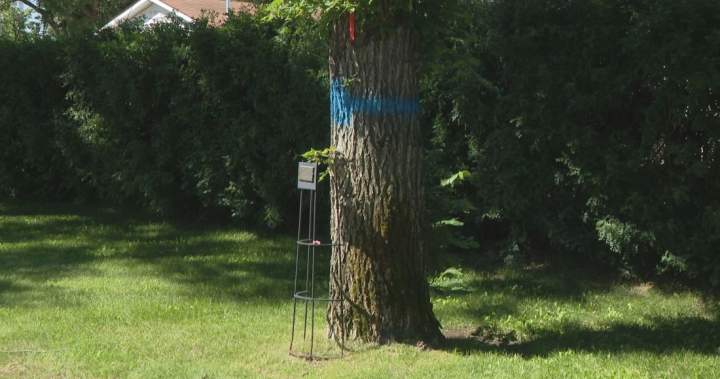
A beloved memorial tree at Saskatoon’s historic Woodlawn Cemetery is being removed after testing positive for Dutch elm disease, marking a somber moment for the community and those who honor Canada’s military heritage. The City of Saskatoon announced on July 16, 2026, that the infected tree, which was dedicated to “The Officers of the Forever Scotland Camp,” must be cut down to prevent the spread of this devastating invasive disease.
Understanding Dutch Elm Disease and Its Impact
Dutch elm disease (DED) represents one of the most serious threats to elm trees across North America. According to the Canadian Food Inspection Agency, the disease is caused by two types of fungi that effectively block a tree’s ability to transport water through its vascular system. This blockage eventually leads to the death of the tree, often within just a few growing seasons.
All American elm species are considered highly susceptible to this contagious disease. One of the most concerning aspects of DED is its ability to spread through root contact between infected and healthy trees, making containment efforts particularly challenging in areas where elm trees are planted close together.
“The city has taken measures to try to protect these trees as much as possible, as much as practical. That includes increased surveillance, rapid removal of trees that are infected, as well as the inoculation of some trees,” stated Thai Hoang, the city’s park director, during a news conference.
A Century of Military Remembrance
The Memorial Avenue of Trees at Woodlawn Cemetery holds profound historical significance for Saskatoon and all of Canada. The memorial was originally established to honor more than 66,000 Canadian troops who made the ultimate sacrifice during the First World War. The first memorial service at the site took place in June 1923, following its creation in 1922.
Over the decades, the memorial has expanded to include dedications to service members who lost their lives in subsequent conflicts, including the Second World War and the Korean War. City of Saskatoon archivist Jeff O’Brien described the Memorial Avenue of Trees as “an ongoing celebration” of military service members who defended their country.
The symbolic importance of these trees cannot be overstated. As O’Brien eloquently explained, “A tree is a symbol of the triumph of life over death. Trees, like soldiers, serve beyond their lives.” This philosophy has guided the memorial’s stewardship for over a century.
The Affected Tree’s History
The tree scheduled for removal was the 19th tree planted at the memorial site. It was dedicated by the Daughters of Scotland, a organization committed to preserving Scottish heritage and honoring those of Scottish descent who served in the military. The plaque in front of the tree reads “To honour the officers of the Scotland Forever Camp.”
The emotional weight of removing such a significant tree is not lost on city officials. Hoang acknowledged the difficulty of this decision, stating that tree removal is “something we do with a heavy heart. And it is something that hits us pretty hard here at the city.”
Preventive Measures and Future Plans
The City of Saskatoon has implemented several strategies to combat Dutch elm disease and protect the remaining trees at the memorial:
- Increased surveillance and monitoring of all elm trees on the property
- Rapid removal of any trees that test positive for the disease
- Inoculation programs for healthy trees to boost their resistance
- Regular testing and inspection of trees in high-risk areas
- Commitment to replacing any removed trees with disease-resistant species
City officials have confirmed that other trees at the site will undergo re-inspection and testing as necessary to ensure the disease has not spread further. Approximately 2,100 elm trees are located at Woodlawn Cemetery, with an estimated 112 of those situated along Memorial Avenue.
Honoring a Century-Old Promise
When Saskatoon city council approved the Memorial Avenue of Trees more than 100 years ago, they made a promise to the advocates who championed the memorial: if a tree comes down, another must be planted in its place. Hoang confirmed that the city intends to honor this commitment, as it has done previously when trees were removed for various reasons.
However, the replacement tree will not be an elm species. This decision reflects the ongoing challenges posed by Dutch elm disease and the city’s commitment to selecting species that can thrive without the threat of this devastating infection. The choice of replacement species will likely consider factors such as disease resistance, climate adaptability, and aesthetic compatibility with the existing memorial landscape.
For the Latin community in Canada and all residents who value the preservation of military heritage, the removal of this memorial tree serves as a reminder of the ongoing challenges faced in maintaining these important historical sites while also highlighting the dedication of municipal officials to preserve these spaces for future generations.
