


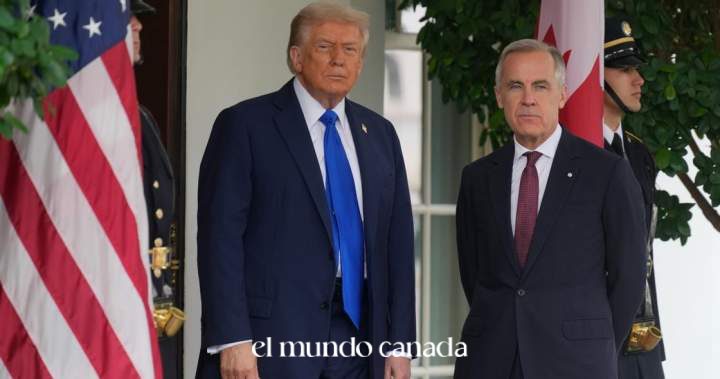
In a significant development for Canada-U.S. trade relations, President Donald Trump announced a three-day pause on the 50% tariffs that were scheduled to take effect against Canada just after midnight. The move comes after both countries reached what Trump described as a trade deal, offering temporary relief to Canadian businesses and consumers who were bracing for devastating economic impacts.
The announcement, made via Truth Social on Tuesday evening, marks a potential turning point in the ongoing trade tensions between the two neighboring nations. For Latin American communities in Canada who work across various industries affected by these tariffs, this pause provides a brief window of hope amid economic uncertainty.
Trump’s Tariff Pause Announcement
In his Truth Social post, Trump explicitly stated that he paused the 50% tariffs against Canada that were scheduled to begin the following morning. The three-day postponement was granted based on what he called progress toward a finalized agreement between the two nations.
The U.S. President wrote in his statement that Canada and the United States, subject to the finalization of documents, have reached a deal. He also made a notable reference to the Keystone XL Pipeline, suggesting it “may be awoken from the grave.”
Trump followed his initial announcement with a fictional image of himself slamming an illustration of the pipeline into the ground, emphasizing his enthusiasm for potentially reviving the controversial energy project that was halted by former President Joe Biden.
Canada’s Response and Ongoing Negotiations
Prime Minister Mark Carney issued a statement on Tuesday evening acknowledging that Canada and the United States had made “substantial progress” in trade negotiations. However, he cautioned that important work still needs to be done before any final agreement is reached.
“Canada and the United States had made substantial progress in trade negotiations, but important work still needs to be done.”
According to Carney, Washington agreed to postpone the 50% tariffs until the end of August 21 while talks continue. The Prime Minister spoke directly with Trump by phone on Tuesday, just hours before the U.S. was set to implement the new tariffs.
The Canadian negotiating team was led by Canada-U.S. Trade Minister Dominic LeBlanc and chief negotiator Janice Charette, who were present in Washington, D.C. working to secure an agreement with their American counterparts.
Keystone XL Pipeline: Potential Revival
The Keystone XL Pipeline has emerged as a central element in these trade discussions. Former President Joe Biden signed an executive order to revoke the permit for the project on his first day in office, effectively killing plans to transfer oil from Alberta to Nebraska.
Trump returned to the White House determined to reverse that decision. Earlier this year, he signed an executive order for permits to revive parts of the Keystone project, signaling his administration’s commitment to expanding North American energy infrastructure.
It remains unclear how much of the trade negotiations between Canadian and American officials specifically focused on the energy project. However, Trump’s repeated references to the pipeline suggest it played a significant role in reaching the tentative agreement.
Impact on Canadian Goods and Industries
By reaching this tentative deal, Canada has avoided 50% tariffs on roughly $28 billion worth of Canadian goods that were scheduled to take effect at midnight. The planned levies would have targeted a remarkably wide range of products across multiple sectors.
Products that were set to face the 50% tariffs included everyday items such as hockey sticks, honey, wine, and cement. For Canadian businesses that rely on exports to the United States, the potential impact would have been devastating.
Canadian officials were also seeking relief on existing tariffs that currently target steel, aluminum, lumber, and autos. These industries employ thousands of workers across Canada, including many members of the Latin American community.
It remained unclear late Tuesday exactly what terms had been agreed to under the tentative agreement that Trump announced. The lack of specific details has left many industry groups cautious about celebrating prematurely.
What This Means for Canadians
For the Latin community in Canada and all residents who depend on cross-border trade, this tariff pause offers temporary breathing room. Many Canadian businesses had been preparing for what they described as potentially devastating impacts on their operations.
Industry groups have noted that while the tariff pause is welcome news, it does not bring long-term trade certainty. The three-day window simply provides more time for negotiators to finalize the details of any comprehensive agreement.
Workers in the manufacturing, agriculture, energy, and automotive sectors should monitor developments closely. The outcome of these negotiations will directly affect job security and economic opportunities across Canada.
For those working in affected industries, this is an important time to stay informed about how any final agreement might impact your workplace. Provincial governments in Alberta and other regions are actively monitoring the situation and preparing resources for affected workers.
The coming days will be critical as Canadian and American negotiators work to finalize the terms of this tentative deal. Both governments face pressure to reach an agreement that protects jobs and economic interests on both sides of the border.
What products were targeted by the 50% tariffs?
The 50% tariffs were set to affect approximately $28 billion worth of Canadian goods, including hockey sticks, honey, wine, and cement. Canadian officials were also seeking relief on existing tariffs affecting steel, aluminum, lumber, and autos.
How long is the tariff pause?
Trump announced a three-day pause on the 50% tariffs. According to Prime Minister Carney, Washington agreed to postpone the tariffs until the end of August 21 while negotiations continue.
What is the Keystone XL Pipeline?
The Keystone XL Pipeline was a project designed to transfer oil from Alberta to Nebraska. Former President Biden revoked its permit on his first day in office. Trump has signed executive orders to revive parts of the project and referenced it prominently in his tariff pause announcement.
📘 Follow El Mundo Canada on our social networks: Facebook | Twitter
