


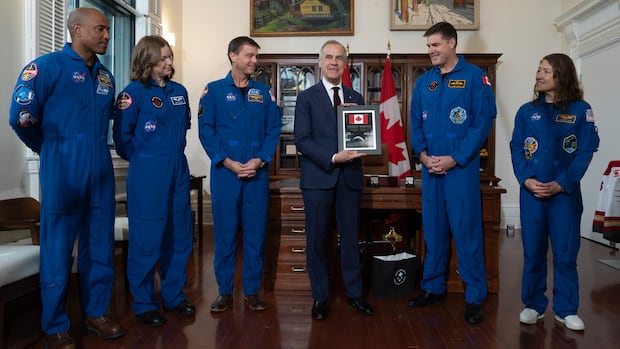
Prime Minister Honors Crew’s Historic Lunar Journey
Prime Minister Mark Carney welcomed the Artemis II astronauts to Canada this week, praising the four-member crew for inspiring an entire nation with their upcoming mission around the moon. The visit marks a significant moment for Canada’s space program and highlights the country’s growing role in deep space exploration.
The crew touched down in Ottawa and Montreal for a series of public appearances and official meetings. Canadian astronaut Jeremy Hansen joined his American crewmates to celebrate the historic mission that will send humans beyond low Earth orbit for the first time in over 50 years.
Canada’s Role in the Artemis Program
The Artemis II mission represents a watershed moment for Canadian space exploration. Hansen will become the first Canadian to travel to deep space when the crew launches aboard NASA’s Orion spacecraft.
Canada secured this historic seat through its contribution of the Canadarm3 robotic system to the Lunar Gateway station. This next-generation robotic arm will play a crucial role in constructing and maintaining humanity’s first permanent outpost orbiting the moon.
The partnership between the Canadian Space Agency and NASA demonstrates Canada’s continued leadership in space robotics.
“This mission has united Canadians from coast to coast to coast,” Carney told reporters during the Ottawa ceremony. The Prime Minister emphasized how space exploration serves as a powerful symbol of international cooperation and scientific achievement.
Meet the Artemis II Crew
The four astronauts selected for this groundbreaking mission bring diverse expertise and extensive experience to the crew.
Commander Reid Wiseman leads the team with previous experience aboard the International Space Station. The NASA astronaut has logged significant time in space and will oversee all mission operations.
Pilot Victor Glover serves as the spacecraft’s second-in-command. Glover made history as the first Black astronaut to complete a long-duration mission on the ISS.
Mission Specialist Christina Koch holds the record for the longest single spaceflight by a woman. Her expertise in spacecraft systems will prove invaluable during the lunar journey.
Mission Specialist Jeremy Hansen rounds out the crew as Canada’s representative. The former fighter pilot trained extensively for space missions and will conduct critical experiments during the flight.
Public Events Draw Thousands of Supporters
The astronauts’ Canadian tour generated tremendous public enthusiasm. Crowds gathered in both Ottawa and Montreal to catch a glimpse of the historic crew.
Children and families lined the streets, many holding signs and wearing space-themed costumes. Schools organized special field trips to attend the public events.
“Seeing the excitement on young faces reminds us why exploration matters,” Hansen said during a Montreal appearance. “We carry the dreams of the next generation with us.”
The crew participated in educational events designed to inspire students pursuing careers in STEM fields. These outreach efforts align with both NASA’s and the Canadian Space Agency’s goals of cultivating future scientists and engineers.
Timeline and Mission Objectives
The Artemis II launch is scheduled to send the crew on a trajectory around the moon and back to Earth. The mission will last approximately 10 days and cover roughly 1.3 million kilometers.
Unlike the Apollo missions of the 1960s and 70s, Artemis II will not land on the lunar surface. Instead, the crew will test critical systems needed for future landing missions while traveling farther from Earth than any humans in history.
Key mission objectives include:
- Testing the Orion spacecraft’s life support systems with humans aboard
- Evaluating communication systems at lunar distances
- Conducting scientific observations of the moon’s surface
- Demonstrating the spacecraft’s heat shield during high-speed Earth reentry
The mission serves as a crucial stepping stone toward Artemis III, which will land the first woman and first person of color on the moon.
What This Means for Canada’s Space Future
Canada’s involvement in the Artemis program extends far beyond a single astronaut seat. The country has committed significant resources to lunar exploration and stands to benefit from scientific discoveries and technological advancements.
The Canadarm3 contribution alone represents billions in investment and thousands of high-skilled jobs for Canadian workers. Companies across the country have secured contracts supporting various aspects of the Artemis infrastructure.
“Space exploration drives innovation that benefits everyone,” noted officials from the Canadian Space Agency. Technologies developed for lunar missions often find applications in medicine, telecommunications, and environmental monitoring.
International Cooperation Strengthens Space Exploration
The Artemis program represents an unprecedented international partnership. Beyond Canada, the European Space Agency, Japan Aerospace Exploration Agency, and other partners contribute essential components and expertise.
This cooperative approach differs significantly from the competitive space race of the Cold War era. Nations now recognize that exploring deep space requires pooling resources and knowledge.
Carney emphasized this collaborative spirit during his remarks. The Prime Minister highlighted how space exploration demonstrates what humanity can achieve when countries work toward common goals.
Looking Ahead to Lunar Exploration
The Artemis II astronauts’ visit to Canada builds momentum for the upcoming mission and reinforces public support for continued space investment. As launch preparations continue, Canadian officials express confidence in the program’s success.
Hansen’s journey will inspire a new generation of Canadian scientists, engineers, and explorers. His selection proves that Canada punches above its weight in space exploration.
For those following the mission, NASA and the Canadian Space Agency will provide extensive coverage of all Artemis II activities.
