


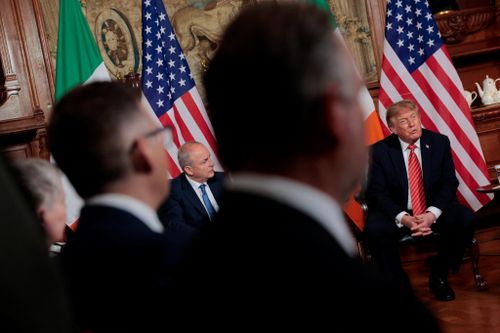
Donald Trump made waves during his weekend visit to Ireland on Saturday, September 12, 2026, declaring that he would “love to see” the Republic of Ireland unite with British-run Northern Ireland. The controversial statement breaks with decades of American diplomatic tradition on the sensitive issue, while the U.S. President also offered optimistic remarks about a potential Canada trade deal that could come “fairly soon.”
Trump’s Unprecedented Unification Remarks
Speaking after a meeting with Irish Prime Minister Micheal Martin in Dublin, Trump ventured into politically delicate territory that previous American presidents have carefully avoided. The president expressed his personal support for what he described as the eventual joining of the two parts of the island of Ireland.
“Well, I don’t want to cause any problems, but I will tell you, I’d love to see it unified. The way I look at it, it’s going to happen eventually… I think it would be a fantastic thing.”
Trump acknowledged that the United Kingdom would have input on the matter, stating “the UK will have something to say about it” but maintained his view that unification would be beneficial. This marks a significant departure from the traditionally neutral stance American leaders have maintained regarding the Northern Ireland question.
British Government Swift Response
The British government responded rapidly to Trump’s comments. Prime Minister Andy Burham’s office issued a statement indicating that in his view, there was no majority public support for a referendum on Irish unification. The office further stated that another referendum would not occur until that public sentiment changed.
The sensitivity surrounding this issue stems from decades of deadly sectarian violence in Northern Ireland during the 20th century. The conflict centered on whether the territory should remain part of the United Kingdom or join the Republic of Ireland. Previous U.S. presidents have deliberately avoided touching on the subject given its complex and painful history.
Canada Trade Deal: What It Means for Canadians
For Canadians watching closely, Trump’s comments on the U.S.-Canada trade war offered a potentially positive signal. The president suggested that Canada was eager to reach an agreement and that a resolution could materialize in the near future. This news comes as Trump tariffs continue affecting Canadian businesses and consumers across the country.
“Canada wants to make a deal very badly. Canada has to treat our farmers better. They can’t charge our farmers tariffs. You’ll probably see a deal with Canada fairly soon.”
The trade conflict between the two North American neighbors has created uncertainty for businesses and workers on both sides of the border. Trump’s assertion that Canada had treated American farmers unfairly with its tariffs echoes complaints he has made throughout the ongoing dispute. However, his optimistic tone suggests negotiations may be progressing behind the scenes.
Read more: B.C. Election 2026: 7 Parties Battle for Votes
Iran War: Trump Claims Conflict Will End Soon
The president also addressed the ongoing U.S. war with Iran, which began on February 28, 2026. Trump stated the conflict would “end very soon” — a prediction he has made repeatedly in the past without it materializing. He claimed that the conclusion of hostilities would cause oil prices, which have surged due to the war, to “come tumbling down.”
Trump vigorously defended his decision to launch the military operation against Iran, centering his justification on preventing nuclear proliferation. The president made dramatic claims about how close Iran had allegedly been to acquiring nuclear weapons capability.
“Iran cannot have a nuclear weapon. They were two weeks away from having a nuclear weapon. If they had it, they would have blown up Israel, they would have blown up the Middle East.”
The war with Iran does not enjoy majority support among the American public, particularly given Trump’s campaign promises to keep the United States out of foreign “forever” conflicts. The disconnect between his campaign rhetoric and his administration’s military actions has drawn criticism from both political allies and opponents.
Context: Golf Tournament and Diplomatic Meetings
Trump’s weekend trip to Ireland was primarily motivated by the Irish Open golf tournament, being held at a course he owns on the country’s Atlantic coast. However, the visit also included significant diplomatic engagements, with Trump meeting both the Irish president and Prime Minister Micheal Martin.
The talks between Trump and Martin took place at Farmleigh House in Phoenix Park in Dublin. Trump received a military welcome upon his arrival in the country, underscoring the formal diplomatic nature of portions of his visit despite its golf-centered origins. Martin has led Ireland twice since 2020, making him a seasoned partner for these high-level discussions.
The combination of leisure activities and international diplomacy has become characteristic of Trump’s travel schedule, allowing him to pursue business interests while conducting official state business. The Irish Open provides global visibility for his golf properties while the meetings with Irish leaders address substantive policy matters.
For the Latin community in Canada, these developments carry significant implications. The potential easing of U.S.-Canada trade tensions could stabilize employment in sectors that have faced uncertainty. Meanwhile, soaring oil prices linked to the Iran conflict continue to impact household budgets across Canada, making any movement toward resolution particularly relevant.
Trump’s next major international engagement remains unannounced, though the Irish Open tournament continues through the weekend at his Atlantic coast property. The British government has not indicated plans for further formal response to his unification comments beyond the initial statement from Prime Minister Burham’s office.
Did Trump officially call for Irish unification?
Trump expressed personal support for eventual Irish unification, saying he would “love to see it unified” and calling it “fantastic.” However, this was a personal opinion, not an official U.S. policy announcement. He acknowledged the UK would have input on the matter.
What did Trump say about a Canada trade deal?
Trump stated that Canada “wants to make a deal very badly” and predicted that a deal could happen “fairly soon.” He criticized Canadian tariffs on American farmers as unfair treatment that needed to change.
When did the U.S.-Iran war begin?
According to Trump’s statements, the U.S. war with Iran began on February 28, 2026. Trump defended the military action by claiming Iran was “two weeks away” from having a nuclear weapon.
Why was Trump in Ireland?
Trump traveled to Ireland primarily to watch the Irish Open golf tournament at a course he owns on the country’s Atlantic coast. He also met with Irish Prime Minister Micheal Martin and the Irish president at Farmleigh House in Dublin.
📘 Follow El Mundo Canada on our social networks: Facebook | Twitter | Instagram
