


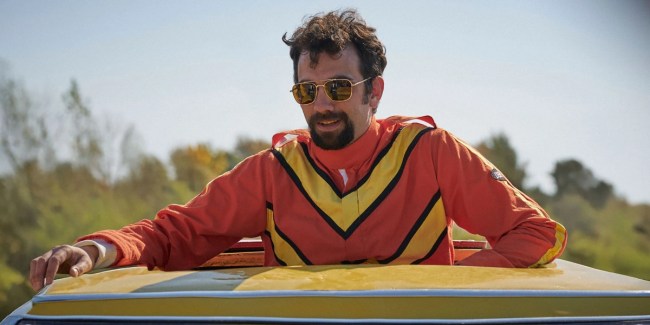
On September 12, 2026, Canadian cinema celebrates a remarkable addition to its catalogue with The Stunt Driver, a new film that lovingly recreates one of the country’s most audacious stories of ambition and fear. Directed by Michael Dowse, the filmmaker behind proudly regional comedies like FUBAR and Goon, this production transforms the legendary tale of Canadian stuntman Ken Carter into a compelling narrative about a man whose dreams of flying through the air constantly battled with his wavering courage.
The film draws heavily from the 1981 National Film Board of Canada documentary The Devil at Your Heels, directed by Robert Fortier. That original documentary chronicled Carter’s ambitious and ultimately troubled attempt to jump a rocket-powered car over the Saint Lawrence River, a one-mile-long stream separating Canada and the United States. The new fictional adaptation uses Fortier’s work as both foundation and springboard to explore deeper emotional territory.
Jay Baruchel Leads Ensemble Cast
Jay Baruchel takes on the role of Ken Carter, exaggerating the real man’s bravado to achieve both comic and poignant ends. The Canadian actor brings to life a character who was a born showman, someone who left school at 14 years old with only a grade-four education and refused the conventional nine-to-five working life that most people accept.
Carter dedicated his existence to death-defiance largely as a bid to achieve cultural immortality. The documentary’s narrator, Gordon Pinsent, summarized the stuntman’s philosophy perfectly when he declared that Ken Carter jumped cars for a living, and people simply liked watching him do it.
The supporting cast features impressive talent. Ed Helms plays Dick Keller, a fictionalized version of dragster Slam’n Sammy Miller, the engineer enlisted to help build a rocket car capable of withstanding such an incredible feat. Dan Bakkedahl portrays promoter Bill Wilkins, a character loosely based on sports agent Edward Keating.
Documentary Origins and Creative Adaptation
The original documentary The Devil at Your Heels profiles Carter during his tumultuous five-year journey to complete the river jump. The film chronicles various technical challenges with the car and ramp, bouts of ill-timed uncooperative weather that frequently delayed production, and unceasing financial difficulties in funding and promoting the stunt itself.
Dowse’s approach lovingly cannibalizes the documentary by following its broad structure and semi-faithfully reenacting many classic scenes. One memorable moment shows the paunchy Carter struggling to get into his ill-fitting jumpsuit. The filmmakers often used the subjects’ actual words as dialogue for the ensemble of comic actors.
Yet Dowse didn’t set out to create a narrative photocopy of a non-fiction film. Instead, he uses the source material to explore the internal crisis of a man whose commitment to flying through the air stands at odds with his wavering mettle and private fears.
Unique Narrative Structure
The Stunt Driver opens with Carter undergoing hypnosis live on a Montreal radio program to probe the roots of his fears. Under this clever framework, Dowse’s film then depicts Carter’s crusade to jump the river in all its complicated glory.
The story follows the initial plan to sell the stunt to ABC’s Wide World of Sports, a strategy that eventually falls apart when money dries up after years of preparation delays. Promoter Wilkins eventually scraps the idea of a televised event along with plans for a live audience.
Instead, the project pivots to becoming a film sold to Japanese investors for an international audience. This shift in strategy adds another layer of complexity to an already challenging endeavor.
Behind the Scenes Challenges
The documentary captured myriad behind-the-scenes shenanigans that the fictional film recreates, including multiple exploding fuel tanks and Hollywood backers eager to sell an event film at all costs. Through all these obstacles, Carter and his goal remained constant, even as his nerve was tested and the finish line kept receding into the distance.
A small documentary crew led by a fictional version of Robert Fortier, played by Joe Cobden, films Carter alongside his wife Gloria, portrayed by Laurence Leboeuf. The footage spans years as Carter confidently boasts on camera about his excitement to make the jump.
Privately, however, Carter frets about his chances of getting burned up in the air or drowning in the river. The latter scenario proves particularly terrifying given that the real Carter could not swim, making a water landing potentially fatal regardless of the car’s performance.
Canadian Cinema Celebration
Michael Dowse has built his reputation on proudly regional comedies featuring lovable, debaucherous underdogs. His previous work includes FUBAR, which became a cult classic, and Goon, another beloved Canadian comedy. This background makes him likely the perfect person to fictionalize such a rich piece of Canadian history.
The film represents an important moment for Canadian storytelling, bringing a uniquely national tale to new audiences who may never have encountered the original documentary. For the Latin community in Canada, it offers insight into the country’s cultural history and its tradition of celebrating unconventional heroes.
“Ken Carter jumps cars for a living, and people like to see him do it.”
Why This Story Matters
Ken Carter wanted to amaze the world before he was finally through, as the original documentary proclaimed. His story embodies the peculiarly Canadian combination of ambition and modesty, of dreaming big while facing practical obstacles at every turn.
The Saint Lawrence River jump represented more than just a stunt. It symbolized the possibility of bridging two nations, of achieving something unprecedented, and of leaving a permanent mark on popular culture. Whether Carter succeeded or failed, his commitment to the attempt defined his legacy.
For viewers interested in Canadian history, stunt performance, or simply compelling character studies, The Stunt Driver offers all three wrapped in Dowse’s characteristic comic sensibility.
Where to Watch
Canadian audiences can look forward to experiencing this tribute to one of the country’s most daring figures. The film joins a growing catalogue of Canadian productions that celebrate uniquely national stories while appealing to international audiences.
The production demonstrates continued interest in mining Canadian history for compelling narratives. Stories like Ken Carter’s remind viewers that extraordinary characters exist everywhere, not just in Hollywood mythology.
For those unfamiliar with the original 1981 National Film Board documentary, watching The Devil at Your Heels before or after the fictional adaptation provides valuable context and an opportunity to compare approaches to the same remarkable story.
Frequently Asked Questions
Who plays Ken Carter in The Stunt Driver?
Jay Baruchel plays the role of Ken Carter, exaggerating the real stuntman’s bravado for both comic and poignant effect throughout the film.
What documentary inspired The Stunt Driver?
The film draws from The Devil at Your Heels, a 1981 National Film Board of Canada documentary directed by Robert Fortier that chronicled Ken Carter’s five-year attempt to jump the Saint Lawrence River.
Who directed The Stunt Driver?
Michael Dowse directed the film. He previously directed Canadian comedies including FUBAR and Goon, making him well-suited to tell this uniquely Canadian story.
The film’s theatrical release continues through fall 2026, with Canadian cinema chains featuring The Stunt Driver as part of their lineup celebrating homegrown productions and the remarkable true stories that inspire them.
📘 Follow El Mundo Canada on our social networks: Facebook | Twitter | Instagram
