


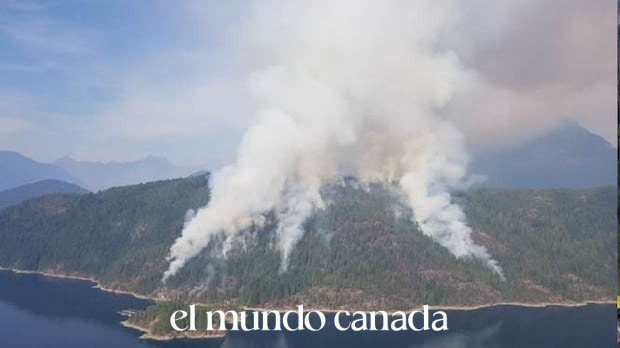
A U.S. man has lost his appeal against a $2.35 million fine for starting a devastating wildfire in a British Columbia ecological reserve. The B.C. wildfire fine appeal decision, handed down by the province’s Court of Appeal, upholds one of the largest environmental penalties ever imposed on an individual in Canadian history.
John Henry Osborne of Washington State sparked the 2018 blaze on East Redonda Island, destroying approximately 280 hectares of protected old-growth forest. The court’s ruling reinforces British Columbia’s commitment to holding individuals accountable for catastrophic environmental damage caused by negligence.
The East Redonda Island Wildfire: What Happened
A Campfire That Destroyed Protected Wilderness
The wildfire began on July 9, 2018, when Osborne left a campfire unattended on East Redonda Island, located in the Discovery Islands archipelago between Vancouver Island and the mainland. The remote island hosts the Rendezvous Islands Ecological Reserve, a provincially protected area established to preserve rare coastal ecosystems.
Strong winds quickly spread the flames from Osborne’s campfire into the surrounding forest. The fire burned for weeks, ultimately consuming 280 hectares of irreplaceable old-growth forest and sensitive ecological habitat.
The ecological reserve protects unique plant communities and wildlife habitats that took centuries to develop. Environmental experts testified that the damaged ecosystems may require hundreds of years to recover fully.
Investigation and Criminal Charges
British Columbia Conservation Officers launched an extensive investigation into the fire’s origins. Evidence conclusively linked the blaze to Osborne’s abandoned campfire.
Authorities charged Osborne under the Wildfire Act, British Columbia’s primary legislation governing fire prevention and liability. The act allows the province to recover firefighting costs and impose penalties for fires caused by human negligence or recklessness.
The Original Court Ruling and Historic Fine
Judge Imposes Record Penalty
In 2023, a B.C. Provincial Court judge found Osborne liable for the wildfire and ordered him to pay $2.35 million in damages and penalties. The amount included firefighting costs, environmental remediation expenses, and punitive damages reflecting the severity of the destruction.
The judge emphasized several aggravating factors in determining the penalty amount:
- The fire occurred in a protected ecological reserve
- Osborne ignored fire restrictions in effect at the time
- The defendant showed disregard for Canadian environmental laws
- The ecological damage was extensive and potentially irreversible
Legal experts noted the fine represented one of the largest individual wildfire penalties in Canadian history.
Osborne’s Defense Arguments
During the original trial, Osborne’s legal team argued the penalty was disproportionate to his actions. They contended that while their client acknowledged starting the fire accidentally, the resulting fine exceeded reasonable bounds for an individual defendant.
The defense also raised concerns about the calculation methods used to determine environmental damages and questioned whether international defendants should face such severe Canadian penalties.
The Appeal Court Decision
Arguments Presented to the Court
Osborne appealed the ruling to the British Columbia Court of Appeal, arguing the trial judge made errors in law and imposed an unreasonably harsh penalty. His lawyers maintained the fine was excessive and failed to account for his limited financial means.
The appeal focused on three main arguments:
- The trial judge incorrectly applied the Wildfire Act’s penalty provisions
- The environmental damage calculations were speculative
- The fine violated principles of proportionality
Crown prosecutors defended the original judgment, arguing the penalty appropriately reflected the catastrophic environmental harm caused by Osborne’s negligence.
Court Upholds Original Penalty
The B.C. Court of Appeal dismissed Osborne’s appeal in its entirety. The three-judge panel found no errors in the trial judge’s reasoning or application of the law.
Writing for the court, the justices emphasized that individuals who cause wildfires through negligence must face meaningful consequences. The panel noted that British Columbia’s wildfire laws exist specifically to deter careless behavior during fire season.
The court rejected arguments that the fine was disproportionate, stating that environmental penalties must reflect the true cost of ecological destruction.
Implications for Wildfire Liability in Canada
Strengthening Environmental Accountability
The ruling sends a powerful message about wildfire liability in British Columbia and across Canada. Legal analysts suggest the decision will influence future cases involving human-caused wildfires on protected lands.
The case establishes important precedents regarding:
- International enforcement of Canadian environmental penalties
- Calculation methods for ecological damage assessment
- Proportionality standards for wildfire-related fines
British Columbia has experienced increasingly severe wildfire seasons in recent years due to climate change. Provincial authorities hope strong penalties will encourage greater compliance with fire restrictions.
Fire Prevention During Peak Season
The case highlights the critical importance of fire safety when camping or recreating in wilderness areas. British Columbia regularly implements campfire bans during high-risk periods, and violations can result in significant penalties even without causing fires.
Outdoor enthusiasts should always:
- Check current fire restrictions before heading outdoors
- Ensure campfires are completely extinguished
- Never leave fires unattended
- Carry emergency firefighting supplies
Collection Challenges Remain
Enforcing the Judgment Across Borders
While Osborne lost his appeal, collecting the $2.35 million fine presents practical challenges. As a U.S. resident, Osborne’s assets may not be readily accessible to Canadian authorities.
British Columbia officials have indicated they will pursue all available legal avenues to enforce the judgment. This may include seeking recognition of the Canadian court order in U.S. courts.
