


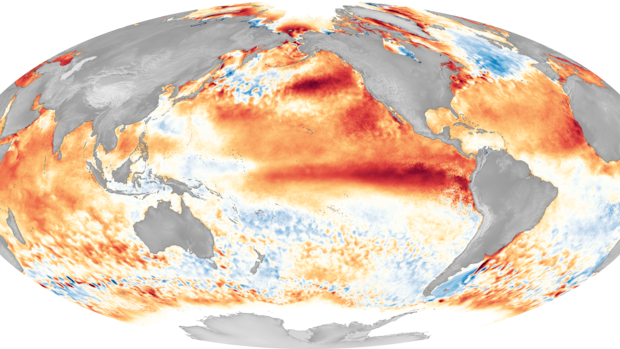
The phrase “super El Niño” has started appearing in headlines again, sparking concern among those who remember the devastating climate impacts of past extreme events. However, climate scientists are urging calm regarding the El Niño 2025 forecast, explaining that while conditions may shift later this year, there’s no immediate cause for alarm.
Recent predictions from major climate agencies have detected early signals that El Niño conditions could develop in the coming months. But experts emphasize that these early indicators don’t guarantee a powerful event, and the public should understand the difference between possibility and certainty.
What Is El Niño and Why Does It Matter?
El Niño refers to a climate pattern characterized by unusually warm ocean temperatures in the equatorial Pacific Ocean. This phenomenon significantly influences global weather patterns, affecting everything from hurricane activity to agricultural yields across multiple continents.
During an El Niño event, the normal east-to-west trade winds weaken or reverse, allowing warm water to spread eastward across the Pacific. This shift disrupts typical atmospheric circulation patterns, triggering cascading effects worldwide.
The impacts can include increased rainfall and flooding in some regions while causing severe droughts in others. Previous strong El Niño events have contributed to coral bleaching, wildfires, and significant economic disruptions in agriculture-dependent communities.
Current Climate Conditions and Predictions
Climate monitoring agencies, including the National Oceanic and Atmospheric Administration (NOAA) and the World Meteorological Organization, continuously track Pacific Ocean temperatures and atmospheric conditions for signs of developing El Niño or La Niña patterns.
As of spring 2025, scientists have observed some warming trends in key Pacific regions. However, these observations remain within the range of natural variability, meaning they don’t yet meet the technical thresholds for declaring an official El Niño event.
Forecasters use sophisticated computer models to predict how ocean-atmosphere interactions might evolve over the coming months. These models currently show mixed signals, with some suggesting El Niño development by late 2025 while others indicate neutral conditions may persist.
Understanding the “Super” El Niño Label
The term “super El Niño” describes exceptionally strong events where sea surface temperature anomalies significantly exceed typical El Niño thresholds. The events of 1997-1998 and 2015-2016 earned this designation, causing widespread global impacts.
Scientists caution against using this dramatic label prematurely. The intensity of any developing El Niño depends on numerous factors that remain uncertain months in advance. Predicting whether a forming event will become “super” strength requires waiting until conditions fully develop.
Climate researchers note that media coverage sometimes amplifies worst-case scenarios, creating unnecessary public anxiety. While preparedness remains important, premature panic serves no constructive purpose.
Why Early Predictions Carry Uncertainty
The spring predictability barrier represents a well-known challenge in El Niño forecasting. During March through May, climate models struggle to accurately predict how Pacific conditions will evolve because small changes can push the system toward very different outcomes.
This inherent uncertainty means that current predictions carry significant margins of error. A forecast suggesting possible El Niño development by autumn doesn’t guarantee that outcome will occur, nor does it indicate how strong any potential event might become.
Scientists recommend treating early-season forecasts as useful guidance rather than definitive predictions. As summer progresses, model accuracy typically improves, providing clearer pictures of what the remainder of the year might bring.
Historical Context and Perspective
Looking at El Niño history provides valuable perspective on current concerns. These events occur irregularly, typically every two to seven years, and vary dramatically in strength and duration.
The 2023-2024 El Niño, which recently concluded, brought elevated global temperatures and contributed to record-breaking heat worldwide. However, it didn’t reach “super” intensity, demonstrating that not every El Niño event becomes extreme.
Climate scientists emphasize that the planet has experienced numerous El Niño events throughout recorded history. While these phenomena cause significant impacts, communities and ecosystems have repeatedly demonstrated resilience and adaptation capabilities.
What Should You Actually Do?
Rather than worrying about uncertain future scenarios, experts recommend focusing on practical preparedness measures that make sense regardless of specific climate predictions.
Understanding your region’s typical El Niño impacts helps identify relevant risks. Coastal areas might face increased storm activity, while agricultural regions could experience altered precipitation patterns. Local emergency management agencies often provide region-specific guidance.
Staying informed through reliable sources remains essential. Government climate agencies provide regular updates based on the latest observations and model outputs. Avoiding sensationalized media coverage helps maintain appropriate perspective on developing situations.
The Bigger Picture: Climate Change Context
Any discussion of El Niño must acknowledge the broader context of climate change. Rising global temperatures influence how El Niño events manifest, potentially intensifying certain impacts while modifying others.
Scientists continue studying how a warming planet affects the frequency and intensity of El Niño-Southern Oscillation (ENSO) patterns. Research suggests complex interactions that make simple predictions about future trends challenging.
This uncertainty underscores the importance of building climate resilience across communities, infrastructure, and agricultural systems. Preparing for variable conditions makes sense regardless of whether any specific El Niño event materializes.
Conclusion
The current El Niño 2025 forecast suggests possibility rather than certainty, and experts urge measured responses rather than alarm. While monitoring continues and predictions will sharpen in coming months, premature worry about a “super” event serves no beneficial purpose. Stay informed through authoritative sources, understand your local risks, and focus on practical preparedness measures that build long-term resilience against climate variability.
