


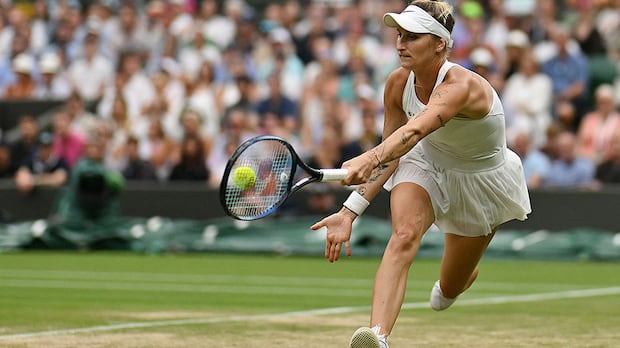
Marketa Vondrousova, the 2023 Wimbledon champion who captured hearts with her stunning grass-court triumph, has received a four-year suspension from professional tennis. The Vondrousova doping ban stems from her refusal to provide a sample during an out-of-competition drug test in December 2024.
The International Tennis Integrity Agency (ITIA) announced the sanction on Sunday, marking a dramatic fall from grace for the Czech star. At just 25 years old, Vondrousova now faces the prospect of being sidelined until 2028, potentially ending her career at the elite level.
What Led to the Four-Year Tennis Suspension
The ITIA statement revealed that anti-doping officials attempted to collect a sample from Vondrousova at her residence in Prague on December 17, 2024. According to the agency, the Czech player refused to comply with the testing procedure.
Under the Tennis Anti-Doping Programme, refusing to submit to sample collection carries the same consequences as testing positive for a banned substance. The rules exist to maintain integrity in professional tennis and ensure all athletes compete on a level playing field.
Vondrousova’s suspension officially began on February 13, 2025, the date she accepted a provisional suspension. The ban will extend through February 2029, meaning she will miss four full seasons of professional tennis.
Vondrousova’s Response and Legal Options
The 25-year-old has not publicly commented on the suspension or the circumstances surrounding the December incident. Her management team has remained silent since the ITIA announcement.
Players facing anti-doping sanctions have the right to appeal decisions to the Court of Arbitration for Sport (CAS). However, cases involving refusal to test typically face an uphill battle in appeals, as the burden falls on the athlete to prove exceptional circumstances.
The ITIA noted that Vondrousova accepted the provisional suspension in February, which suggests she may not contest the ruling. Her decision to accept rather than fight the preliminary ban often indicates an athlete has exhausted or chosen not to pursue available defenses.
A Career Defined by One Magical Fortnight
Vondrousova’s Wimbledon victory in 2023 remains one of the most surprising Grand Slam triumphs in recent memory. She became the first unseeded woman to win the Championships in the Open Era, defeating Ons Jabeur in the final.
Her journey to that title seemed improbable. Vondrousova had struggled with injuries throughout her career and entered the tournament ranked outside the top 40. Yet she navigated the draw with remarkable composure, never dropping a set en route to the trophy.
Before Wimbledon, Vondrousova had reached the 2019 French Open final as a teenager, showcasing her immense potential. She also claimed an Olympic silver medal at the Tokyo Games in 2021, losing to Belinda Bencic in the gold medal match.
The Broader Impact on Women’s Tennis
The tennis doping suspension adds another chapter to the sport’s ongoing battle with anti-doping violations. Women’s tennis has seen relatively few high-profile doping cases compared to other sports, making this situation particularly notable.
Current and former players have not publicly addressed Vondrousova’s suspension. The WTA Tour has deferred all communications to the ITIA, which serves as the independent body handling integrity matters in professional tennis.
The timing creates additional complications for tournament organizers. Vondrousova was set to defend her Wimbledon title in 2024 but withdrew due to injury. Now, her name will be permanently associated with this suspension rather than her grass-court heroics.
Understanding Anti-Doping Testing in Tennis
Professional tennis players must make themselves available for testing both in and out of competition. The whereabouts system requires athletes to provide detailed information about their location, training schedules, and overnight accommodations.
Out-of-competition testing serves a crucial function in detecting performance-enhancing drugs that athletes might use during training periods. Some substances provide benefits during preparation but clear the system before competition.
Refusing a test—or failing to be present at a declared location during a specified window—triggers serious consequences. The Tennis Anti-Doping Programme treats such violations severely because they undermine the entire testing framework.
Athletes can only avoid sanctions for missed tests by demonstrating compelling justifications. Acceptable reasons are narrowly defined and typically involve documented emergencies or circumstances entirely beyond the athlete’s control.
What Happens Next for Vondrousova
The four-year ban effectively sidelines Vondrousova until she turns 29. For a player whose game relied on finesse, movement, and tactical intelligence rather than pure power, a return at that age remains theoretically possible.
However, the practical challenges extend beyond physical conditioning. Vondrousova will lose her ranking entirely and would need to rebuild through lower-level events or rely on protected ranking provisions if she returns.
Her prize money and ranking points from events dating back to the violation will also be stripped. The ITIA has the authority to void results achieved during any period of non-compliance.
The Vondrousova doping ban stands as a cautionary tale about the strict requirements facing professional tennis players. What began as a fairytale Wimbledon triumph has ended with a four-year suspension that may define her legacy more than any trophy.
Tennis fans and the broader sports community will watch closely to see whether Vondrousova appeals the decision or accepts this outcome. For now, her name joins an unfortunate list of athletes whose careers were derailed by anti-doping violations.
